The Electric Vehicle Association Northern Ireland gave an oral presentation to the Committee for Infrastructure in May 2021. The document below was submitted to the members in May 2024 as an update on the EV landscape here. Our recommendations to the Committee are in bold below.
Public Charging Infrastructure
While Northern Ireland’s poor reputation on public charging infrastructure is widely recognised, over the past two years the number of DC Rapid Chargers has surged from 20 to 130. This underscores a more positive shift, indicating increased investment by private Charge Point Operators expanding the network across NI.
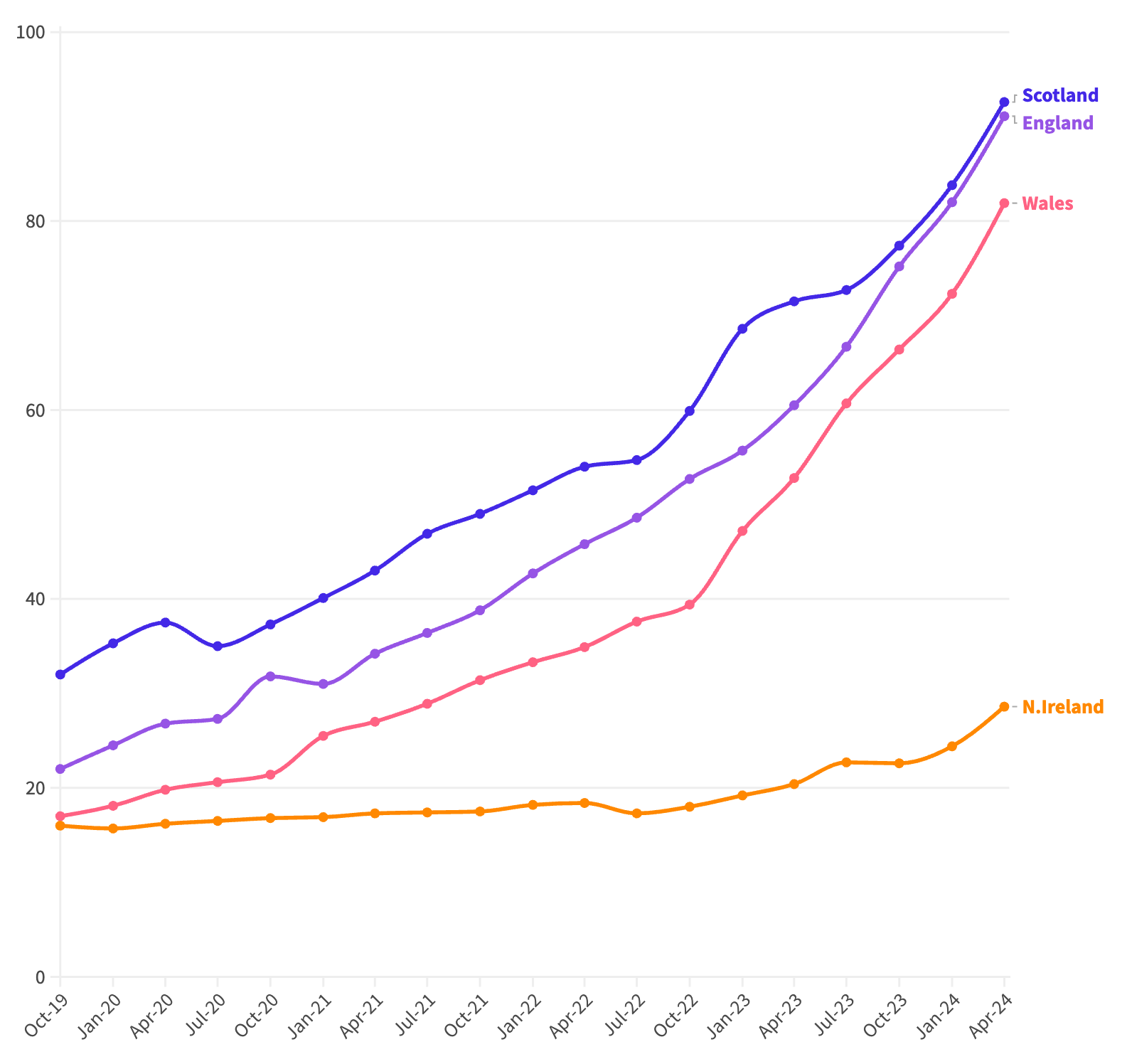
Nevertheless, progress is relative. This graph shows the growth in chargers of all speeds per 100,000 population for a fair comparison across the regions. As can be seen, despite recent growth, NI remains an outlier, years behind England, Scotland and Wales.
In December 2021, the then incumbent chargepoint operator presented to the Infrastructure Committee, stating that they “recognise that the perception of the network is an inhibitor to EV uptake”. There is no doubt that the lack of a fit-for-purpose network has been a barrier to adoption here.
EV Uptake
These issues, along with the absence of any effective EV policy, have resulted in the lowest uptake of electric vehicles across the UK and Ireland. Although sales of new Battery Electric Vehicles (BEVs) in Northern Ireland increased by 42% in 2023 compared to 2022, this growth was insufficient to match the progress seen in other regions. The proportion of new car sales that were full Battery Electric Vehicles in 2023 was as follows:
- 11.6% Northern Ireland
- 16.5% United Kingdom
- 18.7% Republic of Ireland
We can no longer remain the least prepared region of these islands. Further inaction will leave us with an uncompetitive economy, a reduction in tourism, increasing transport poverty and pressure on our domestic retail car industry. We are now left with the challenge of accelerating our progress to catch up and this can only be achieved with a comprehensive EV policy. The transition to electric vehicles must form an important pillar of the new Northern Ireland Transport Strategy due to be released this year.
ZEV Mandate
The Zero Emissions Vehicle Mandate, enacted into law in England, Scotland, and Wales in January 2024, establishes targets for car manufacturers to progressively increase the percentage of BEVs sold to 80% of new cars by 2030. This legislation provides certainty around the transition to electric vehicles and incentivises Charge Point Operators (CPOs) to continue to invest in the necessary infrastructure to support it. Once the general election has concluded the Infrastructure Minister should bring the ZEV Mandate to the Assembly for debate so it can be implemented as soon as possible.
Crossing the Pavement
In 2021, DfI commissioned a report which revealed that approximately 80% of households in NI have access to a driveway. However, this also indicates that 1 in 5 residences lack off-street parking, preventing them from charging electric vehicles at home. The report highlights a significant issue in urban areas, noting that 60% of households in Belfast do not have driveway access. Similarly high levels of housing without driveways are likely present in the centres of other towns and cities across Northern Ireland.
Charging an EV using your own home electricity supply is the most cost-effective option; a fact that is not always apparent to decision makers. EV drivers can benefit from Economy 7 night rates, which are currently around 14p per kWh, compared to 49p for Northern Ireland’s largest public AC charging network. This means that charging a typical family EV costs around £7.00 at home, compared to approximately £24.50 using a public charger – more than 3.5 times the cost.
It’s important to emphasise that lamppost chargers and other on-street options are public chargers and do not provide the cost benefits of domestic charging. This cost disparity is set to grow with the introduction of Smart Meters and Agile Tariffs.
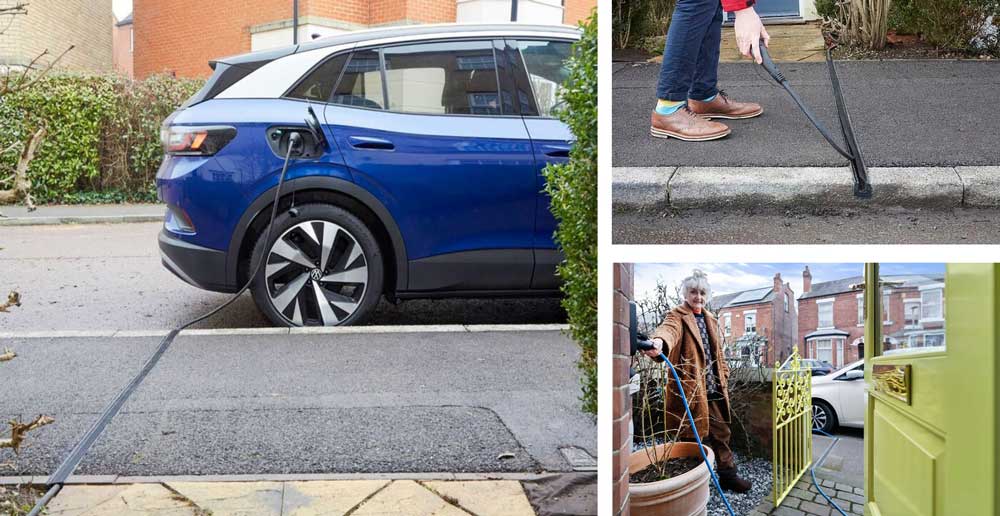
There are multiple solutions available to cross the pavement. The photograph below shows one of the gully style products currently being fitted by councils in GB. To underscore the legitimacy of these solutions, the Department for Transport / OZEV announced in March this year that they are now eligible for government grants here. However, there is currently no way for home owners in NI to do this legally. This effectively prevents owners of certain house types from driving an EV, which is both morally wrong and may also violate the Just Transition principle outlined in our Climate Act.
The Northern Ireland EV Task Force, a cross-department and stakeholder group chaired by DfI, published an Action Plan in November 2022. The paper stated that “charging solutions must also be found for those without access to a driveway, particularly, in our urban areas”.
EVANI has been meeting with department officials for 2 years now on this topic, asking for the launch of a pilot scheme here, without success. We were encouraged to hear DfI representatives tell the Committee at their presentation on 22nd May that they “hope to be able to find those solutions pretty quickly”. By now, many pilot schemes have been completed across GB and the Department should at least create a program to demonstrate the technologies here with proposals on how best to roll out a scheme.
Additionally, we recommend the Committee has discussions with the NI Housing Executive to encourage the development of an EV policy for their tenants that includes home charging solutions.
Modal Shift
We support active travel and public transport to reduce the number of car journeys, where practical and EV infrastructure investment will help to facilitate this. We note however that without any figures, dates or published targets, the Department’s goals for modal shift remain completely undefined.

Spending on the new Belfast Grand Central station is approaching £350 million. DfI’s most recent Travel Survey shows that all the bus and all the train journeys combined account for just 3% of miles travelled in Northern Ireland. By contrast, cars account for 84% of miles travelled, yet where is the equally ambitious spending on the transition to EVs? With the cost of current projects, it is difficult to imagine a time when the Executive would ever have the budget to move significant numbers to public transport. Let’s stop ignoring the reality of travel here. Battery electric vehicles are the only mass-market zero emissions option available and we must invest in decarbonising the 84% by ensuring the transition to EVs becomes a top policy priority.
Planning
Current planning policy is significantly outdated. Some councils are rejecting applications for much needed charging infrastructure, citing a “12 mile” rule for “service stations” from a Department of the Environment Planning Strategy document that is over 30 years old. There is an urgent need to update planning regulations with guidelines that are suitable for a society that is decarbonising.
CPOs inform us that while current permitted development rights enable the installation of some EV chargers, they often do not extend to the electrical cabinets necessary to power them. Revising planning regulations to include these devices within permitted rights will eliminate another barrier to infrastructure deployment.
Also, mandate developers to ensure that dedicated electrical infrastructure is in place to support the mass adoption of EVs in new domestic and commercial developments as well as car parks.
Messaging on Electric Vehicles
While the Department appropriately advocates for active travel and public transportation, its communication regarding electric vehicles is virtually non-existent. Compared to the governments of England, Scotland, Wales and the Republic of Ireland, the central messaging on the transport transition is entirely absent here.
If NI is not going to follow the example of all of its neighbours, who are we taking inspiration from? To support the transition to more sustainable transport, DfI should significantly increase its efforts to promote EVs by utilising its own social media as well as engaging more widely with the public to highlight the advantages of the transition.
Public Fleets – Lead by Example
In November 2021 the then Infrastructure Minister Nichola Mallon, signed the Glasgow Declaration on Zero Emission Cars and Vans on behalf of the Northern Ireland Executive. This commitment means that all government, council and publicly funded fleets must be zero-emissions by 2035. Progress to date has been slow, for example just 0.3% of DfI vehicles have switched so far. We would welcome publication of progress to date across all Executive Department fleets, along with a sight of the planned timeline for the stages to complete this transition.
Blocked Chargers
In December 2023, 27 new rapid chargers were installed across 3 council areas as part of the publicly funded ‘Faster Project’. Since then, our members have been reporting problems at these locations. For example, this photograph shows all 8 of the new rapid chargers at the Newry Leisure Centre blocked, mostly by petrol and diesel cars. This pattern is being repeated across other locations and it is extremely disheartening to see this recently installed and valuable infrastructure rendered completely unusable.
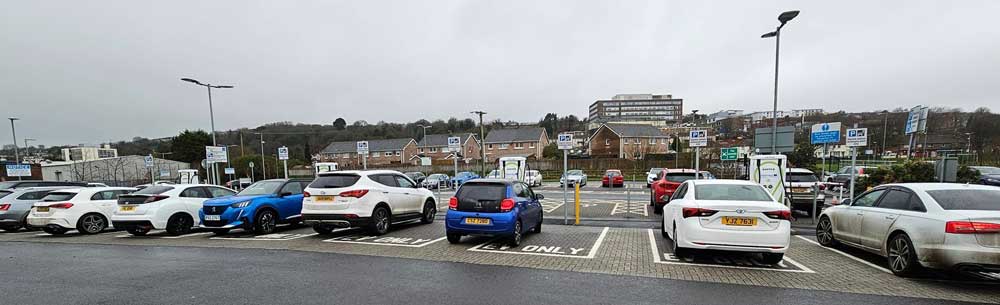
To discourage such inconsiderate behaviour we believe a financial penalty system may be the only effective solution. One of our Councils is introducing a Statutory Car Park Order for enforcement at their EV charging bays. We recommend the Committee and/or Department writes to all Councils here to ensure similar measures are implemented across all their EV spaces as soon as possible. All future schemes must take this issue into consideration and examine how best to make blocking an EV charger an offence.
ORCS Scheme
In August 2022, Minister O’Dowd announced £1.3 million funding from OZEV’s (Office for Zero Emission Vehicles) ORCS (On-Street Residential Charge-point Scheme) along with £470K from the Department to install 124 new on-street EV chargers (now 127). Twenty-one months later, the tender for this project has still not been released, highlighting the challenges of meeting all the statutory conditions in Northern Ireland. We would ask the Committee to engage with the ORCS Council Consortium and DfI to ensure everything possible is being done to aid the installation of these chargers, before the funding expires.
Levelling Up Fund
2.5 years ago, ESB announced a “complete overhaul and modernisation of Northern Ireland’s entire EV charging network including the expansion of the rapid charging network and the deployment of high-power charging hubs”. This was partially funded by a £3.27 million LUF grant. Since then, we have seen replacements for some of their slower AC chargers, but just 1 DC rapid charger replaced and none of the promised DC rapid hubs have appeared. We believe we are also headed towards an expiry date for the levelling up funding. We request that the Committee and/or Department writes to ESB to seek clarification on how this public money will be spent and when, particularly in regard to the DC rapid charging hubs promised here.
East / West
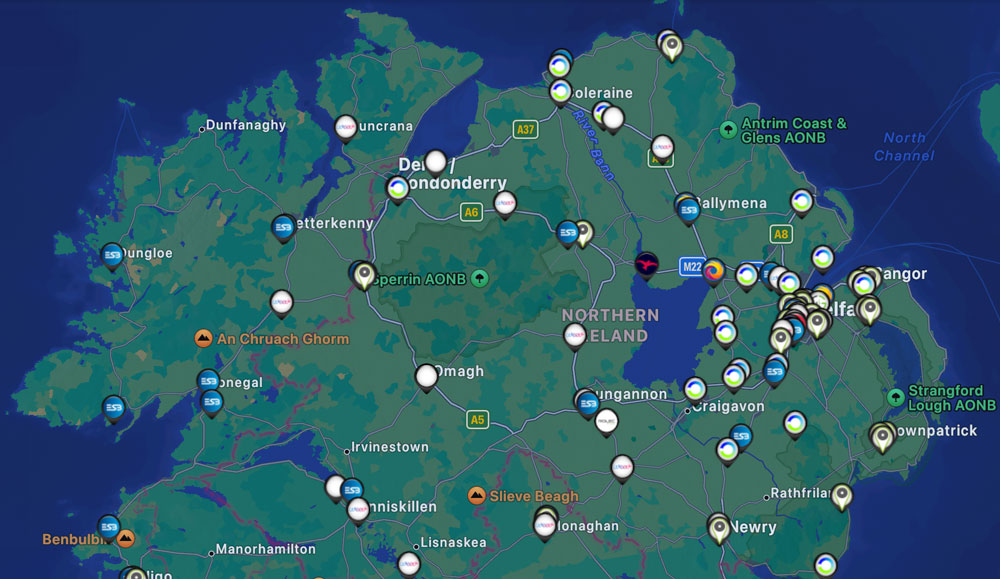
This is a recent map showing the DC Rapid chargers across NI. The rollout in rural areas may remain inadequate as long as there is no clear EV policy or ongoing support for residential and destination charging in these regions. Relying on the market to deliver critical transport and energy infrastructure will not deliver a just transition. We would encourage the Committee to consider the need for intervention on charging infrastructure in rural areas, particularly those west of the Bann.
Other Recommendations
Other recommendations, some of which may sit outside the remit of the Infrastructure Committee:
- Engage with OZEV on Local EV Infrastructure (LEVI) funding proposals for NI
- Socialise Grid Connection Costs (DfE)
- Roll out Smart Meters so Agile Tariffs can be launched here (DfE)
- Promote Work Place Charging and OZEV grant for same
- Request progress update from EV Task Force on its 2022 six-point action plan
- Encourage CPOs to discount rates with time of use tariffs
- Encourage accessibility improvements for public chargers
- Launch a campaign of Mythbusting around EV disinformation
- Encourage Consumer Council to create EV tariff tool
- Encourage Car Clubs to bring EV sharing to NI
- Consider funding interest free or low interest loans for second hand EVs
- Lobby UK government to reduce VAT on public charging to match domestic rate
- Ring fence Barnett consequentials from EV related funding
The Importance of EVs
Our Climate Act has set out ambitious decarbonisation targets, and electrifying transport is crucial to meeting them. In many ways this is the low-hanging fruit, especially given the challenges ahead in other sectors. The following quotes capture their importance in this role:
The Climate Change Committee – “The full transition to electric vehicles will be one of the most important actions to achieve the UK’s Net Zero target”
The Sustainable Energy Authority of Ireland – “Nothing will deliver as much as electric vehicles in terms of direct carbon savings”
While EVs are not a cure-all, they significantly reduce greenhouse gas emissions, improve air quality and are essential to our energy transition and security.
No responses yet